Counterbalance Forklift training in London
The truck most London businesses own. Forks at the front, a heavy counterweight at the back and nothing sticking out to get in the way of a lorry bed, a container or a pallet stack.
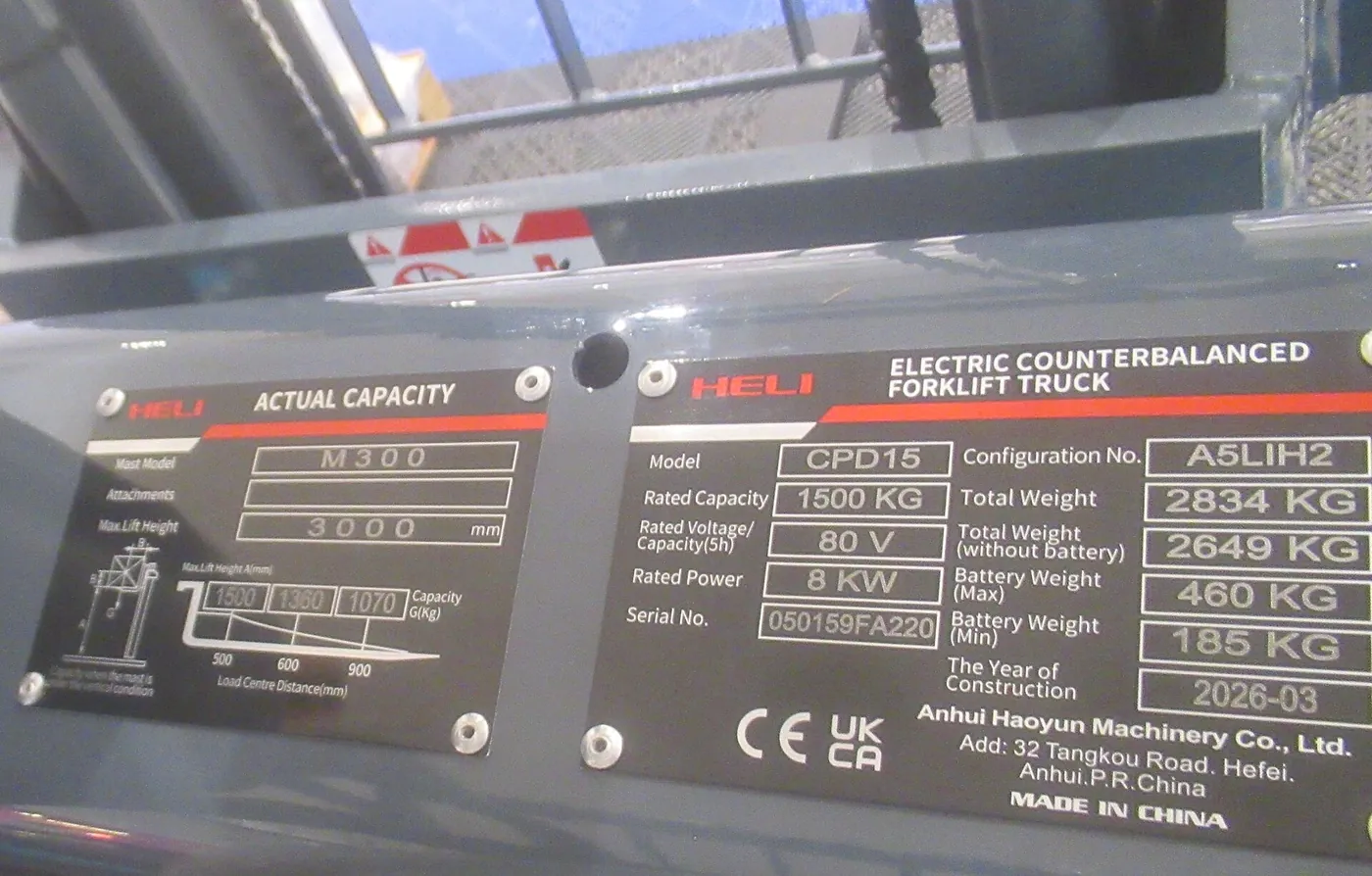
Photo: Heli 2026-08-11 CPD15 forklift 05.jpg by P1898, CC BY 4.0, via Wikimedia Commons.
About counterbalance forklifts
The counterbalance is the forklift everyone pictures, and it is the most common lift truck in London by a distance. Our instructors meet it on every kind of site: the food wholesalers of Park Royal, the builders' merchants of Croydon and Enfield, the print and packaging units of Hayes and Barking, the market traders at New Covent Garden, Billingsgate and New Spitalfields, the self-storage depots on every A-road, the council depots and the theatre scenery stores. The idea is simple. A mast and forks at the front, a block of dense ballast behind the rear axle, and the truck stays on its wheels when the forks are loaded. With no legs or outriggers in front of the load, the operator can drive squarely up to a trailer, a container, a stack or a run of racking.
Two layouts are common. Three-wheel electric trucks have a single or close-coupled pair of drive wheels at the rear and turn almost within their own length, which suits the cramped older warehouses and railway-arch units that London has so many of. Four-wheel trucks, usually diesel or LPG, are heavier, steadier on wet concrete and yard surfaces, and are the norm at merchants, recyclers, scaffolding yards and manufacturers that work outdoors. Masts come in two-stage and three-stage forms, often with free lift so the forks can rise inside a container or under a low door before the mast itself extends, which matters when your building was put up before forklifts existed.
Whatever the make and model, the skills that keep people safe are the same: understanding the stability triangle and the load centre printed on the capacity plate, keeping the load back against the fork heels, travelling low with the mast tilted back, and reversing when the load blocks the view ahead. Side-shift, fork positioners, clamps and other attachments are covered where your truck has them, because each one changes the capacity and the way the truck handles. Training happens on your own truck, in your own yard, with your own pallets.
What the course covers
- Legislation, employer and operator responsibilities
- Pre-use inspection and defect reporting
- Stability triangle, load centres and reading the capacity plate
- Manoeuvring in confined spaces, forward and reverse, with and without load
- Stacking and de-stacking at height in racking and block stacks
- Loading and unloading vehicles, containers, ramps and loading docks
- Refuelling or battery charging, safe parking and shutdown
On site, on your truck, anywhere in London
We bring an accredited instructor to your premises in any London borough or surrounding town. You provide the truck and a safe working area; we provide the theory material, test papers and the HSE-recognised certificate. Novice Forklift Training, Semi-Experienced Forklift Training, Refresher Forklift Training, Conversion Forklift Training are all available for this truck.
Other truck categories
Reach Truck, Double Deep Reach Truck, 4-Way (Multi-Directional) Reach Truck, VNA Truck (Man-Up and Man-Down), Bendi and Flexi (Articulated) Forklift, Pivot Steer Truck, Powered Pallet Truck, Pedestrian Stacker Truck, Telehandler (Telescopic Handler), Order Picker (Low, Medium and High Level), Rough Terrain (Masted) Counterbalance, Side Loader.
Counterbalance Forklift training questions
Do you train on our own counterbalance truck?
Yes. Every course runs at your premises on your truck, so operators learn on the machine they will drive the next morning. The truck needs to be in safe working order with a current Thorough Examination (LOLER) report.
Is the certificate different for electric, LPG and diesel trucks?
No. The certificate is for counterbalance lift trucks within a stated capacity band, whatever the power source. The instructor covers the fuelling or charging routine that applies to your machines.
Our yard is tiny. Is there enough room to train?
Almost always. Many London customers have a yard the size of two lorry bays. The instructor sets out a compact course with cones and uses your real racking and vehicles for the rest. If space is a real problem we will tell you before the course, not on the day.
How many people can one instructor train?
Three novices on one truck is the accredited-body maximum. Refresher courses can take more candidates in a day because each needs less time on the truck. Larger groups mean more instructors or more days; tell us the numbers and we will quote the most efficient way.
Need forklift operators trained in London?